
Balance 2 – Revenue/Costs Lose those losses

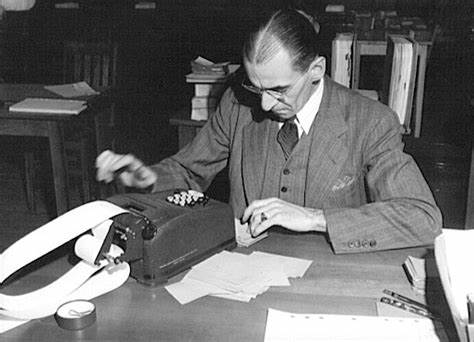
Having spent many years working as an accountant I know a thing or two about Balance Sheets. The most important of which is that they should balance. Ask any accountant about trying to find the error in an extended trail balance (the precursor of the Balance Sheet and Profit & Loss account) and they will regale you with lots of stories of woe. Balance sheets are a snapshot, at one point in time, of a business’ position. Assets on one side and liabilities on the other, hence the term Balance Sheet, although nowadays they are presented in a portrait format with the assets at the top and liabilities at the bottom. The liabilities can be split in two, those owed to others and those owed to the owners of the business. The thing that makes it balance, provided there are no mistakes, are the retained profits for the year. That is a good thing because it allows me to segue into talking about the Profit and Loss account and what I really want to get to, which is losses. Sorry about the circuitous route; however, I wanted to link back to the previous blog (Balance), you will see why later, and Balance Sheets seemed the best way.

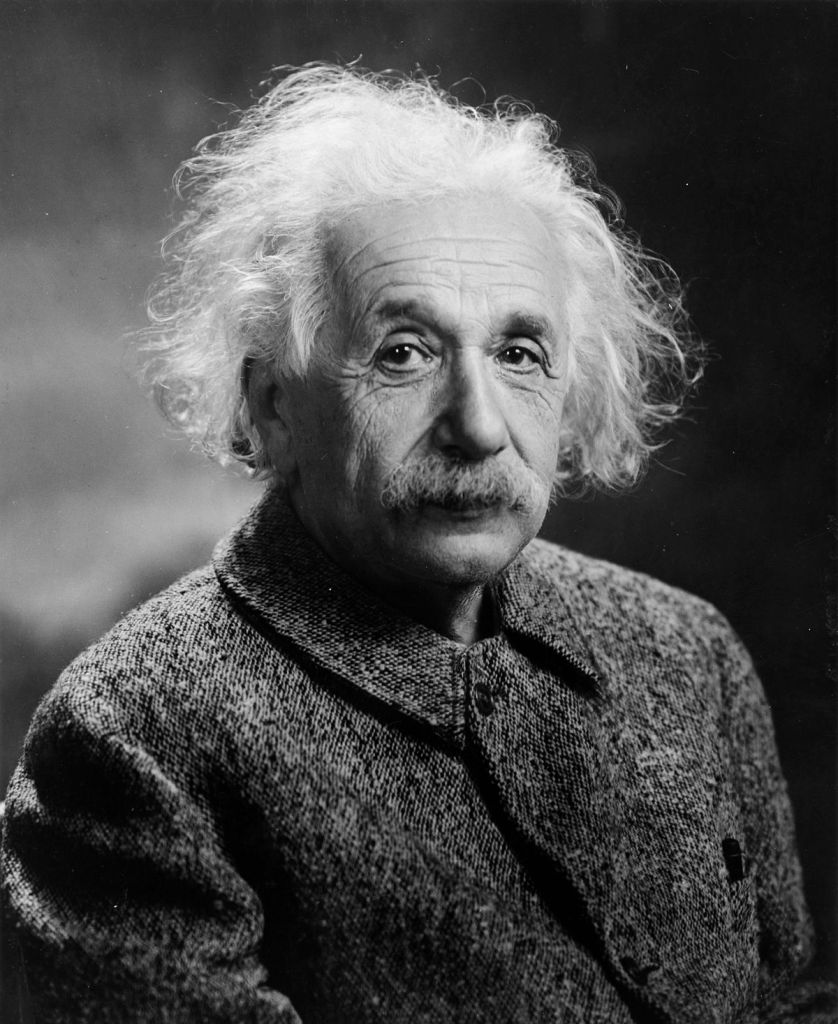
Businesses make losses and sometimes that cannot be avoided, start-up situations for example or coping with a change in circumstances. However, generally losses are a bad thing and to be avoided; there are either too many costs on one side of the scales or too little revenue on the other side or both. Often when management realises there is a problem, they cut costs across the board, perhaps slashing budgets by 10% (most of the time that excludes board salaries) which is not a good idea. It is like deciding you need to lose weight and cutting off a toe, a finger, a snip out of each ear, a bit off your nose, a slice off each buttock and … I think you’ve got the idea. If the business survives the cuts and blood letting it may limp on into the future, but nothing has changed. Albert Einstein said, “Problems cannot be solved with the same mindset that created them.” Or to put it another way “You don’t drown by falling in the water; you drown by staying there.” Edwin Louis Cole.
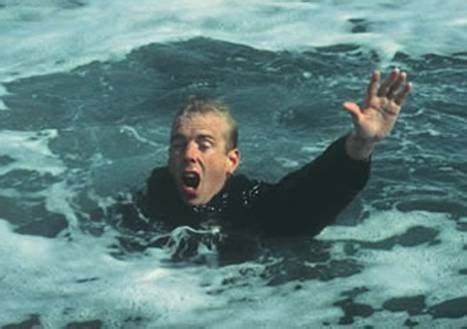
If things are really bad and you are in deep, then the existing team are unlikely to have the right mindset or the ability to pull the business out of the water, or whatever mess it is in.  You need outside help; time to call in the FBI. No, not the American law enforcement people, I mean consultants who have Financial and Business Intelligence. However, be warned, before they get their badge the American FBI agents are extensively trained at Quantico, anyone can call themselves a consultant without any training or qualifications. When you get your outside help, you should look for 4-weight people, not 6-weight people. (See previous post). 6-weight people, while not ideal, will help you, provided they are not charlatans, they will help you reduce the right costs and not cut off your nose. They might demand a metaphorical pound of flesh (professional fees can be expensive); it will be worth it if they have saved the business.

4-weight people will understand your business, the markets it operates in and its processes. They will also understand the markets it could operate in and the processes it could use. They are not confined by convention and what is supposed to happen on different sides of the scales. They may well suggest reducing sales to improve your businesses performance. Radical? Yes. Sensible? Yes. Some customers are just too costly to service; very often the time taken dealing with queries, meetings, making changes, etc is hidden in overheads or general costs of sales and not compared to the revenue that individual customer brings in. Each customer should be weighed in the balance and, if found wanting, cast adrift before they can sink you.

When I had the outdoor goods distribution business, we used to rank customers using a scoring system that included possible sales volume and the cost (including hassle) of doing business with them. We had four levels, Diamond, Gold, Silver & Bronze. There is another class, Lead (those that will weigh you down) but they never got into our CRM system. Obviously, we devoted most of our time and effort to the Diamond Geezers, although we also spent time encouraging our customers to move up the rankings. One of our Silvers was in danger of becoming base metal, they would leave it to the last minute to order and phone through in a panic wanting a delivery the next day. They usually called after our normal deliveries had gone out, so it meant a special trip to the courier’s depot, which was time consuming and expensive.  I analysed their orders and suggested a fixed monthly delivery of stock that would be adjusted if things got out of kilter and that we would wait for payment if their stock level got too high. The result, my admin and delivery costs went down, their sales of our stuff to the public went up (they no longer had times when things were out of stock), so our orders from them went up. That customer moved from Silver to Gold.

Customers: if you can’t make them work for your business ditch them. Sales are vanity, cash is sanity and profit is the purpose of business.


Balance

Belshazzar’s feast

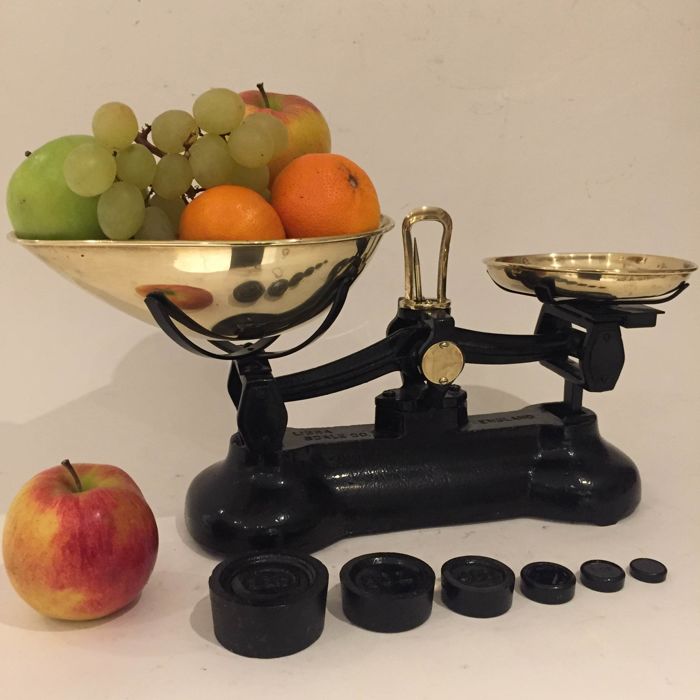
I have been fascinated by scales (the weighing ones not the musical ones) ever since I was about 14 when my music teacher introduced me to Belshazzar’s feast and the wonderful line, the fingers of a hand came forth and wrote upon the wall ‘you have been weighed in the balance and been found wanting’. I have no desire to be found wanting, so have striven hard to do my best.

The scales at the time of Belshazzar, about 500BC are like the ones used until just recently. He would have recognised the scales held by Lady Justice, the statue on top of the Old Bailey. Interestingly, modern day developments in the world of scales has run counter to what happened in other areas. They went from being digital to analogue at the time when the world was becoming digitalised. However, they have now reverted to being digital, mainly because they are electronic.

The first business lesson I learnt from scales was via a puzzle. If you want to weigh up to 40kg using scales, where you put weights in one pan and the object or objects to be weighed in the other, in increments of 1kg what is the least number of weights you need? It is fairly simple mental arithmetic to think, well I need a 1kg then a 2kg, I don’t need 3kg because 1+2 is three, I need 4kg and that means I can reach 7kg with my existing weights so I need an 8kg which will get me to 15, so I need a 16kg, which will get me to 31kg, so I need 32kg and that is it because I will easily get to 40kg with those. So, 6 weights 1,2,4,8,16,&32. WRONG ANSWER!

If you also put weights in the pan that has the object/objects to be weighed something magical happens as you cross the boundary from arithmetic to mathematics; you are, in effect using negative numbers.  So, you still need 1kg, but you don’t need 2kg as you can get there by putting 1kg on the objects side and 3kg on the weight side (3-1=2). With those weights you can get to 4kg, but you don’t need a 5kg weight, you need 9kg (9-4=5). With those you can get to 13kg. Again, you do not need 14kg, you can use 27kg (27-13=14) and that is it, because 13kg+27kg=40kg. Just 4 weights – amazing.

There are quite a few lessons to come out of this. The first is that if you leave the railway lines of conventional thinking and shunt sideways you can sometimes find better solutions. The second is that we are often constrained by the framing of the problem – ‘where you put weights in one pan and the object or objects to be weighed in the other’. This leads people to think of the first solution, 6. The third lesson is that innovation (new thinking) often reduces the barriers to entry. New entrants under the old system would have to make the dies or moulds for 6 different items and purchase 63kg of weight material for each scale sold. Under the new system they only need 4 dies or moulds and 40kg of material. At the same time existing manufactures will have to make 3 new dies or moulds which helps level things up between existing manufacturers and new entrants.

A fourth lesson is that user acceptance is key. I have never seen the eloquent 4 weight solution in practice, presumably because it is complicated to perform and requires a certain amount of numeric mental dexterity. There may be more lessons in there; however, I want to move on.

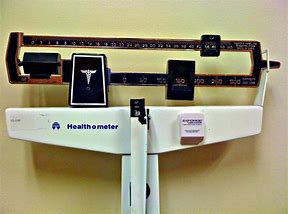
There we a few refinements to the basic scales. If you wanted to weight heavy things it either meant using lots and lots of little weights or lugging big weights onto the scales. Fortunately, someone had a grasp of physics, levers and fulcrums and developed the weighing machine where you slide small weights along an arm to weigh something heavy. It would have been analogue except that notches were put in the arm, turning it into a digital device. Learning points, existing things can be improved; however, we stick with what we know.

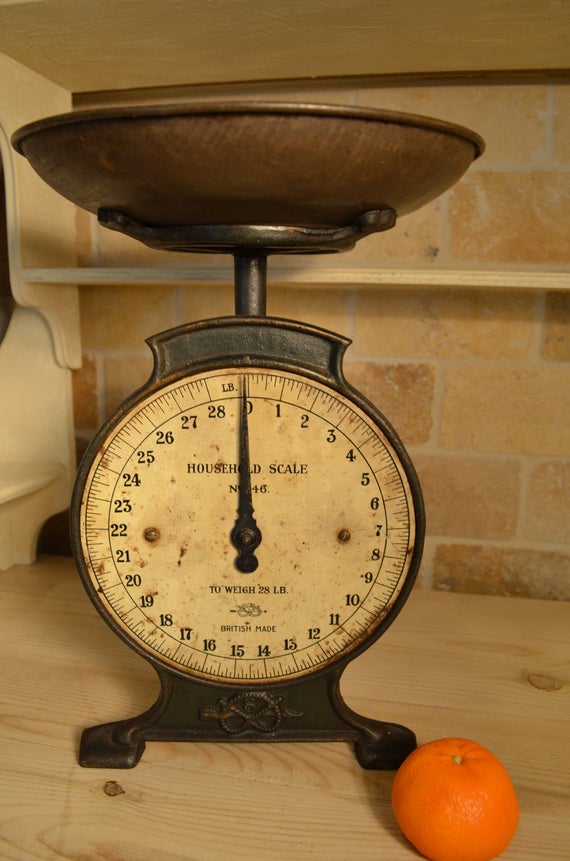
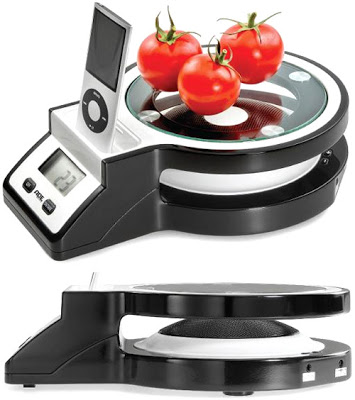
The next change was the biggie! The move to analogue, by using a calibrated spring to measure weight and displaying the results on a dial remarkably similar to an old clock face. This was a paradigm shift. When a paradigm shifts everything is set to zero; existing businesses with an advantage no longer have that advantage. They have balancing things and weights when what they need are springs and things to compress or stretch them and dials.  A further paradigm shift occurred when scales went electronic. Springs were out and piezoelectric transducers in. These electronic gadgets have been developed further, perhaps being over-engineered; you can now get scales with an iPod docking station.

Who, except me, would have thought scales could have been so exciting?

Before leaving the subject, I must mention Verity. She is a Damien Hirst statue on display at the entrance to the harbour in Ilfracombe, North Devon. When the statue was first unveiled, I made a special journey to see it, a 100-mile round trip; I was not disappointed. She is an impressive piece, made mainly of stainless steel, bronze and fibre glass and stands over 20 metres high. Verity bears some similarity to Lady Justice; however, the scales are held behind her back; Damien Hirst describes his work as a “modern allegory of truth and justice”. The statue looks very different depending on which side you view it from.

Verity

There are a few business lessons to be drawn from Verity. How does your business look from different directions? From a customer’s point of view are you easy to do business with or is it a bit of a struggle. Have you tested that other view? Do you have the courage to be bold? Damien was and so was North Devon Council which granted planning permission in the face of strong opposition. They realised that the statue would bring visitors to the town and improve the local economy and it has. W.H. Murray, in a wonderful quote about commitment, says “I have learned a deep respect for one of Goethe’s couplets: Whatever you can do, or dream you can, begin it. Boldness has genius, power, and magic in it!”

———————————————————

About me

I’ve had a varied business life, selling ice-creams, being a Chartered Accountant, working in Financial Services at a senior level, consulting (helping clients improve systems), being a partner in a business supplying outdoor goods to independent retailers and now trading on my own as Trailrunningman. Also during that time I have been a trustee of three different charities and volunteered on a number of projects. My experiences completing tough running races and challenges also transfer to the business world.

I wouldn’t dream of giving any advice, I don’t know you the reader. My time as a compliance officer in financial services ingrained into me the importance of ‘know your client’. I can, however, make general observations and share my thoughts which may help. You should decided whether they are appropriate to your specific circumstances.

Best office ever